Istanbul talks fail
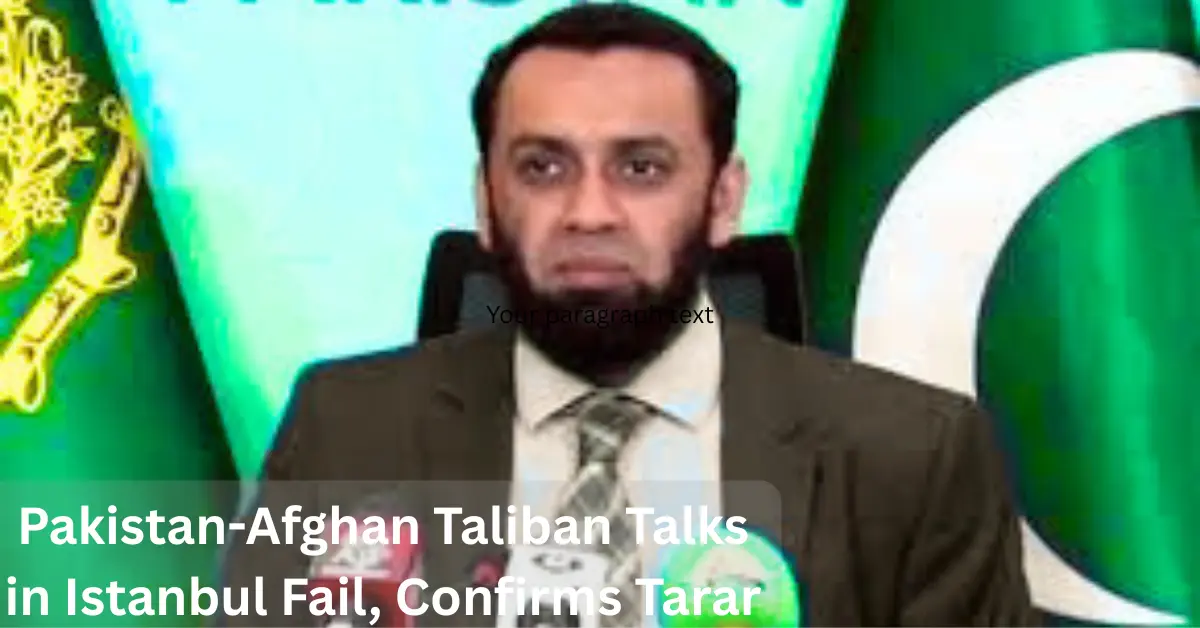
Pakistan’s Information Minister Attaullah Tarar confirmed on October 29, 2025 that the four-day dialogue in Istanbul with the Afghan Taliban ended without agreement. Tarar said the Istanbul talks fail to produce credible commitments from the Afghan side on taking decisive action against militants accused of carrying out cross-border attacks on Pakistan, particularly the Tehreek-e-Taliban Pakistan (TTP) and the Baloch Liberation Army (BLA).
Why the Istanbul talks fail — Islamabad’s position
Tarar accused the Afghan Taliban of deflection and a “blame game” and said Islamabad presented “sufficient and irrefutable evidence” of terrorist networks operating from Afghan soil. He reiterated that Pakistan repeatedly engaged Kabul since the Doha talks but the Istanbul talks fail to yield assurances or a practical mechanism to identify and dismantle sanctuaries used by terrorists. The minister described the Taliban regime as thriving on a “war economy” that resists taking responsibility for cross-border terrorism and instability.
 Pakistan Flood Losses Reach Rs371 Billion, GDP Target Slashed to 3.9%
 KP CM Gandapur Resigns on Imran Khan’s Orders, Backs Afridi
How mediators responded
Qatar and Türkiye — which hosted and mediated the discussions — were thanked by Tarar for their efforts. International reporting from outlets such as Reuters and the Associated Press confirms that mediators worked intensively but could not bridge the gap between Islamabad’s demands and Kabul’s responses. Observers noted that the Afghan delegation frequently deferred to Kabul, which weakened its negotiating flexibility; as a result, the Istanbul talks fail to achieve the verification and guarantees Pakistan sough.
Security implications and recent clashes
The breakdown follows weeks of heightened tensions and violent engagements along the Pakistan-Afghanistan border, including deadly exchanges earlier in October. Islamabad says it has already carried out precision strikes and defensive operations after attacks on Pakistani forces; military statements and media reporting describe casualties on both sides. Analysts warn that since the Istanbul talks fail, the likelihood of further reprisals, cross-border strikes, and a protracted security crisis has increased.
What both sides say
Pakistani security sources told reporters the Afghan delegation repeatedly shifted positions under instructions from Kabul, delaying progress. Afghan sources argued the Taliban government does not have total command-and-control over some militant networks, asserting those groups at times operate autonomously. International coverage suggests mutual accusations of intransigence, with the Istanbul talks fail outcome highlighting the deep mistrust that still colours Islamabad–Kabul diplomacy.
Regional stakes and international reaction
Regional players and mediators have voiced concern about the impasse. Turkey and Qatar — who brokered earlier ceasefire understandings — have urged renewed dialogue. Policy analysts say that a durable solution will require not only pledges but a verifiable, third-party-backed mechanism to monitor compliance and dismantle cross-border sanctuaries. The immediate reality, however, is that the Istanbul talks fail to establish such a framework, prompting calls for structured diplomacy backed by international guarantees.
What’s next — Pakistan’s stated response
Tarar underlined that Pakistan’s security is paramount and vowed to continue “all possible measures” to “decimate the terrorists, their sanctuaries, their abetters and supporters.” With the Istanbul talks fail outcome, Islamabad is expected to combine diplomatic pressure, intelligence operations and calibrated military responses while seeking international support and regional de-escalation mechanisms. For rolling coverage and analysis consult global wire services and local reporting.
 Kurram Border Clash — Pakistan’s Precision Strikes Target Taliban Strongholds
 Government Hajj Scheme 2026 Announced — Complete Process, Dates & Packages
Where to follow live updates
Read the original coverage and ongoing updates on authoritative outlets such as Reuters, AP, Dawn, and Geo News. You can also follow our localized reporting and expert commentary at newscloud.pk for timely updates and deeper context. 📡
Conclusion
The collapse of the Istanbul talks leaves a fragile ceasefire and a diplomatic gap between Islamabad and Kabul. Mediators have urged continued engagement, but with the Istanbul talks fail and no clear enforcement mechanism the region remains vulnerable to renewed clashes. Sustained international involvement, third-party verification, and concrete confidence-building measures will be essential to prevent further escalation. 🔎
FAQs
- Q: Why did the Istanbul talks fail?
A: Pakistan says the Afghan Taliban refused to commit to action against militants and shifted positions during talks; the Afghan side disputes Islamabad’s assertions. - Q: Who mediated the talks?
A: Qatar and Türkiye acted as mediators and hosts for the Doha and Istanbul sessions. - Q: Will violence escalate now the Istanbul talks fail?
A: The risk of escalation is heightened; Pakistan has vowed to take all necessary measures to ensure national security. - Q: Where can I read official statements?
A: Official remarks have been published by Pakistan’s Ministry of Information and international agencies such as Reuters and AP. - Q: How can international actors help?A: Continued diplomatic pressure, transparent monitoring mechanisms and third-party guarantees could encourage compliance and de-escalation between the parties.